About the project
In futures thinking, Horizon 1 is the present system. Horizon 3 is the world we're building toward. Neither horizon is where many of us are actually living, caught between the two, and it's from that uncomfortable middle ground that any real change has to begin.
The writing grows out of a decade spent inside large tech organisations trying to shape how systems affect the people who use them, including years leading player behaviour work at Riot Games across a platform of 140 million players, and out of a longer engagement with the thinkers and practitioners who have been asking these questions well beyond the tech industry, from Grace Lee Boggs to bell hooks to the restorative and relational traditions they helped build.
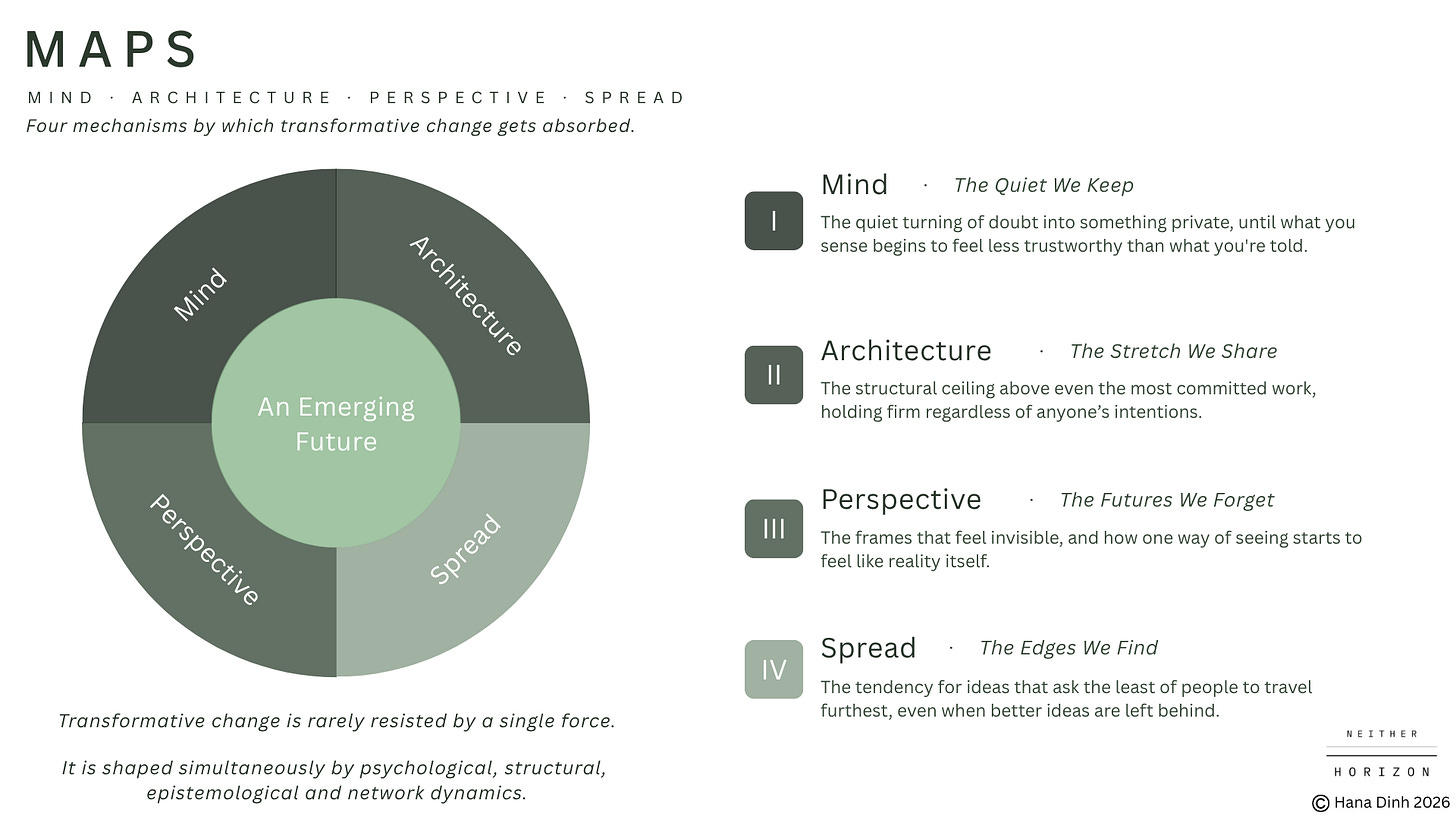
The series explores four mechanisms through which transformative change gets subsumed, from the psychological to the structural to the epistemological to the dynamics of how ideas spread and get absorbed. It's written for people still inside systems who haven't given up on changing them, but who are honest about how hard that actually is.
From practice to inquiry
This work is grounded in practice rather than observation.
My questions took shape inside product teams, building systems that shaped how millions of people interacted with one another. Time and again, the hardest problems I ran into had little to do with technology, and everything to do with incentives, culture, trust, power, and human behaviour.
The more I worked on these problems, the more I found myself looking beyond product management. Areas like systems thinking, restorative practice, behavioural science, futures thinking, and AI governance, had explanations that technology alone couldn't provide.
Neither Horizon is where those experiences become public inquiry.
A note on voice
The writing sits in the restorative and relational approach to systems change, leading with construction, curiosity and honesty rather than confrontation or prosecution.
Subscribe on Substack
Further reading
A running list of the books and writers that shaped this project.
My Reading List