A living list of the writing I return to, particularly in the restorative and relational wing of transformative thinking. Updated as I go.
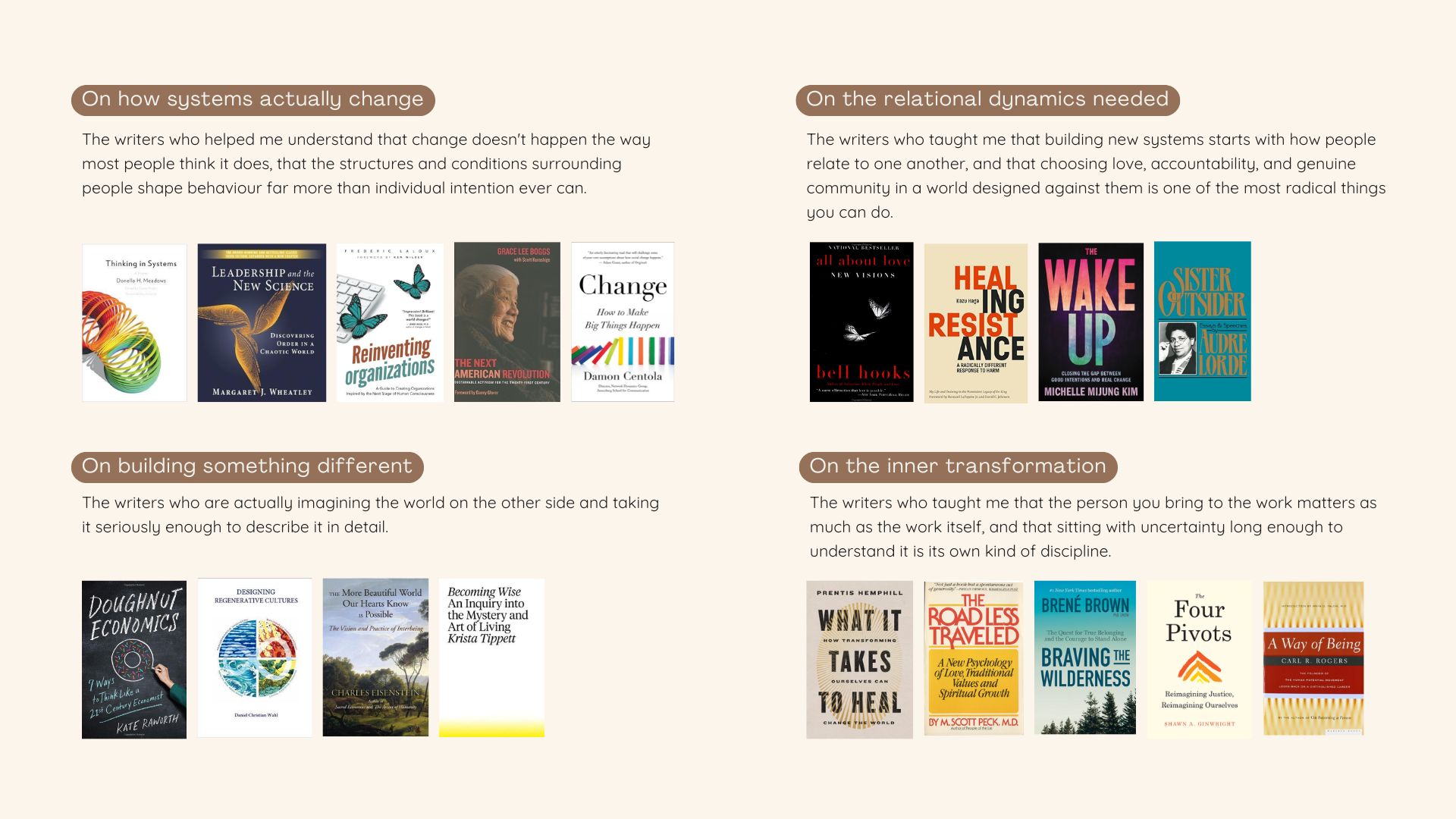
The writers who helped me understand that change doesn't happen the way most people think it does, that the structures and conditions surrounding people shape behaviour far more than individual intention ever can.
How systems behave in ways that surprise and resist us, and where the real leverage points for change actually sit.
What happens when you stop treating organisations like machines and start understanding them as living systems that self-organise around meaning.
A detailed map of how organisations can operate through self-management, wholeness, and evolutionary purpose rather than hierarchy and control.
Revolution as something you build locally, relationally, and generationally, from someone who spent seven decades doing it.
The research on how change actually spreads through networks, why weak ties aren't enough, and why the fringes matter more than the centre.
The writers who taught me that building new systems starts with how people relate to one another, and that choosing love, accountability, and genuine community in a world designed against them is one of the most radical things you can do.
Love understood as a practice and an ethic rather than a feeling, and as the most direct path to ending the patterns of power that shape how we relate to each other.
Nonviolence understood as a lifelong discipline and a martial art, something that requires the same consistent training and practice as any other form of mastery.
An honest look at the gap between good intentions and real change, and what it actually takes to close it.
On difference as a source of power rather than division, and on the cost of silence to the people who can least afford it.
The writers who are actually imagining the world on the other side and taking it seriously enough to describe it in detail.
Economics redesigned around what people need and what the planet can sustain, described with the specificity that makes it possible to imagine.
The book that introduced me to the three horizons framework, and one of the most thorough attempts to describe what a regenerative society could actually look like.
On the space between the story that's ending and the one that hasn't arrived yet, and what it feels like to live there.
What emerges when you spend years listening carefully to people across every discipline and tradition about what it means to live well together.
The writers who taught me that the person you bring to the work matters as much as the work itself, and that sitting with uncertainty long enough to understand it is its own kind of discipline.
On why transforming ourselves is not separate from transforming the world, and why the body knows things the mind refuses to admit.
Love, discipline, and spiritual growth as the unglamorous foundation of becoming a whole person.
On belonging without fitting in, and the courage it takes to hold your own ground when the group would rather you didn't.
Four pivots that move from deficit to possibility, from transaction to relationship, and from the language of what's wrong to the practice of what could be.
The quiet radical idea that being fully present with another person, without agenda, is itself transformative.